

When people consider installing solar panels on their home, they almost always do the same sum: how much their electricity bill will drop and how many years it will take to recover the investment. It is a correct calculation, but an incomplete one. There is a second item that rarely appears in the numbers and that, in many cases, outweighs the accumulated savings: the increase in the property’s value.
A home with solar self-consumption is not just cheaper to run. It is an asset with lower energy costs, a better energy performance certificate rating and, increasingly, better prepared for European regulations that tighten year after year. All of that translates into price and into how quickly it sells.
In this guide we look at what the available data says, why buyers pay more for a home with solar PV, how that value is documented in a sale and which technical decisions make one installation add more value than another.
How much does solar actually add to a home’s value?
There is no single percentage: it depends on the size of the installation, its quality, the price of the home and the market where it is sold. There are, however, solid benchmarks that all point in the same direction.
| Source | Figure | Context |
|---|---|---|
| Zillow (2019) | Up to +4.1% in sale value | US residential market |
| Lawrence Berkeley National Laboratory | Value increase roughly equal to the cost of the installation | Analysis of thousands of US sales |
| SolarReviews (2025) | +6.9% average sale price | Homes with solar PV vs. equivalent homes without |
| Spanish market benchmarks | Typical range of 4% to 8% | Depending on installed capacity, components and property type |
In euros: on a €300,000 home on the Costa del Sol, a 4% to 8% increase means between €12,000 and €24,000. In other words, in many cases the installation pays for itself when you sell, without counting a single euro of the bill savings built up over the years of use.
It is worth being honest about the small print: most of these percentages come from international studies and industry estimates, not from an official Spanish register. The real value is set by the valuer and, above all, by the buyer. What is beyond doubt is the direction of the effect and the mechanisms behind it, which we look at below.
Why buyers pay more for a home with solar self-consumption
1. They are buying lower running costs, not a panel
The buyer is not paying for some modules on the roof: they are buying a lower electricity bill for the next twenty years. A well-sized system covers a very significant share of a home’s daytime consumption (air conditioning, appliances, the pool pump, working from home) and those savings start with the very first bill. If the home also has an electricity tariff suited to self-consumption, the monthly difference is even greater.
2. It improves the energy certificate rating
This is the most underestimated point. The energy performance certificate is mandatory to sell or rent and appears on every property portal next to the main photo. Solar PV reduces the property’s non-renewable primary energy consumption and can therefore raise its rating by one or more letters.
That jump has a market price. The property sector already talks about a green premium (price premiums of 10% to 15% for efficient homes) and a brown discount (discounts of 15% to 20% for poorly rated homes). On an 80 m² flat, that gap can approach €50,000.
3. It gets ahead of regulations that already have deadlines
The EU energy efficiency directive sets clear targets for the housing stock: reaching at least an E rating by 2030 and a D rating by 2033. More than half of Spain’s 25 million homes were built before minimum efficiency standards existed. Those that have already done their homework will start with an advantage; those that have not will compete on price in an increasingly demanding market.
4. It sells faster
A property with self-consumption has a selling point that other listings in the area lack. On a portal where twenty similar homes compete for the same attention, “solar panels installed and registered, electricity bill of €X/month” is the kind of detail that attracts viewings and shortens negotiations. Less time on the market means, in practice, fewer reductions on the asking price.
5. Comfort and the sense of a well-kept home
A house that can run the air conditioning without watching the meter is simply perceived as a better house. And a recent, well-executed installation conveys something buyers value in every corner of a viewing: that the property has been maintained with care.
The energy certificate: the lever that adds the most value
If you could optimise only one variable before selling, it would be this one. The energy rating is the only objective, standardised indicator visible in the listing that compares your home with the rest of the market.
| Situation | Typical effect on price |
|---|---|
| Efficient home (A–B ratings) | 10% to 15% premium over an equivalent home |
| Average home (C–D ratings) | Market price, no significant penalty |
| Inefficient home (E–G ratings) | 15% to 20% discount and longer time on the market |
Two practical points. First: for the installation to be reflected in the certificate, you need to issue a new one after commissioning; the old certificate does not include it. Second: solar PV works especially well with an air-source heat pump, because electrifying heating, cooling and hot water and powering them with your own energy is what really lifts the rating. Today, solar plus an air-source heat pump is the shortest route to an A or B rating for a detached home.
Investment, savings and payback: the numbers
The increase in value is half of the equation. The other half is the savings the installation generates while you live in the house. These are the orders of magnitude we see in residential projects in Málaga and on the Costa del Sol:
- Payback: between 3 and 5 years for homes; between 2 and 3 years for businesses.
- Lifespan: more than 25 years, with manufacturers’ production warranties covering much of that period.
- Result: well over two decades of practically free energy once the installation has paid for itself.
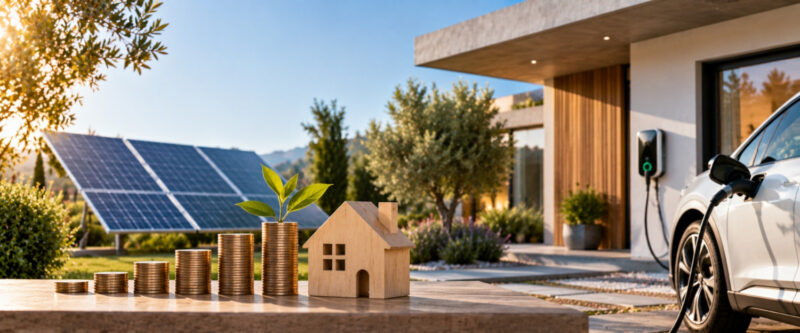
Adding the two together (bill savings over the system’s lifespan and a higher sale price), self-consumption stops looking like an expense and starts looking like what it really is: a home improvement that pays you back twice. To see how this works in real cases, take a look at our solar panel installation projects.
Grants and tax relief that improve profitability
The net cost of the installation, and therefore the payback, depends heavily on the incentives applied. In 2026 several options are still available:
- Income tax (IRPF) deduction: up to 60% for detached houses and entire residential buildings, 40% for a main residence or rented home and 20% for smaller improvements, provided the required reduction in consumption is certified. We break it down in our guide to the income tax deduction for solar panel installation in 2026.
- IBI rebate: up to 50% for several years, depending on the town council.
- ICIO rebate on the building permit.
- Regional grants and EU funds, subject to open calls. You can check the status of solar panel subsidies and the general overview in our complete guide to solar energy and subsidies in 2026.
An important point with a sale in mind: to claim the deductions you need energy certificates from before and after the works, invoices and payment by bank transfer. That same documentation is what later proves the value of the installation to the buyer and the valuer. Keep it from day one.
Not all installations add the same value
Two houses with the same installed capacity can have very different effects on price. What makes the difference:
Full legalisation
An installation without an electrical certificate, without registration or without an assigned CAU (self-consumption code) is a legal problem for the buyer, not an asset. Legalisation is non-negotiable if you want the solar installation to count in the valuation.
Component quality and transferable warranties
Modules and inverters from reputable brands, warranties that do not lapse when ownership changes and an installer you can still reach. If you are interested in the technical detail, we cover it in how to choose the ideal solar panels and in our article on bifacial solar cells.
Correct sizing
An installation that is too small barely moves the energy rating; an oversized one without batteries exports a lot of energy to the grid at a low price. Sensible sizing, matched to the home’s real consumption curve, is what produces convincing numbers during a viewing.
Extras that add value
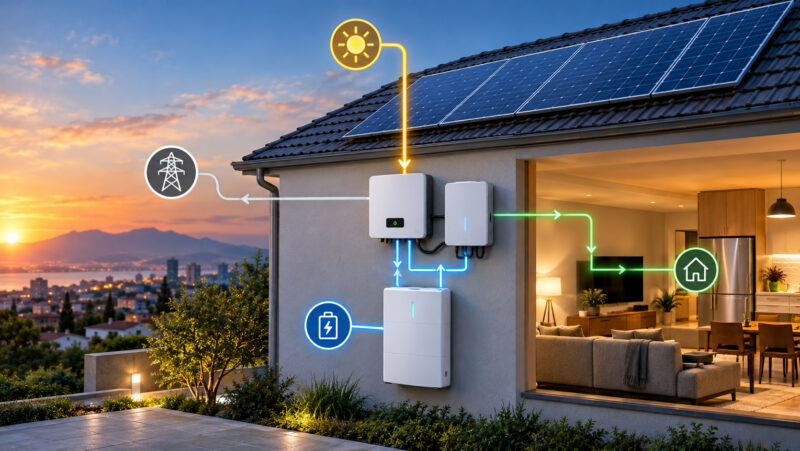
A battery, monitoring with production history and an electric vehicle charging point. The production history is especially powerful: it lets you show the buyer what the house has actually produced and saved, month by month, instead of just promising it.
Appearance and integration
In coastal homes this matters a lot. A tidy installation, with hidden wiring and modules aligned with the roof pitches, reads as part of the house. A makeshift installation detracts from the very first photo in the listing.
How to prove that value when you sell
The increase in value is not automatic: you need to be able to prove it. Prepare a folder with:
- An energy certificate updated after the installation.
- Technical report, electrical certificate and legalisation documents.
- Installation invoices and proof of any grants received.
- Warranties for the modules, inverter and installation, with the transfer of ownership.
- Production and savings report for the last 12 months.
- Before-and-after comparison of electricity bills.
And put it in the listing: installed capacity in kWp, annual production, average monthly savings and year of installation. A listing that says “solar panels” sells less than one that says “5 kWp solar PV system installed in 2025, 6,800 kWh/year, average bill of €28/month, energy certificate B”.
Mistakes that reduce value
- Not renewing the energy certificate after the installation: the improvement exists, but it is not recorded anywhere.
- Unlegalised installations that force the buyer to regularise them on their own.
- Losing the documentation and being unable to prove either the investment or the warranties.
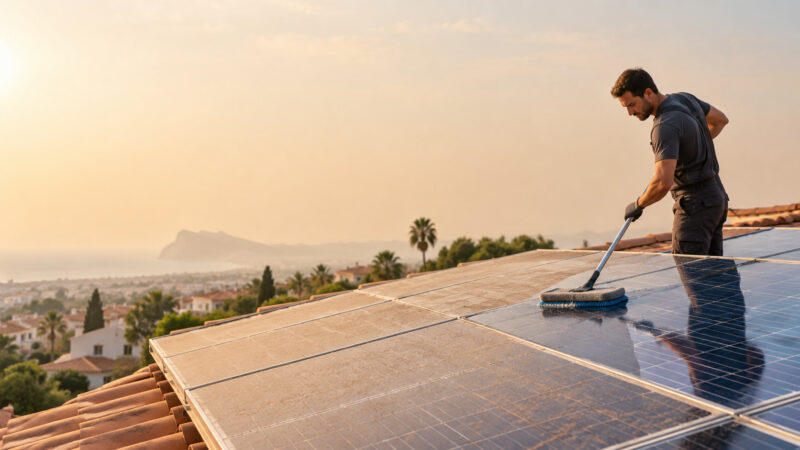
- Not cleaning or checking the modules before viewings: dirt and Saharan dust reduce production and make a poor impression.
- Choosing on price alone installers who then disappear: a warranty with no company behind it is worthless in a negotiation.
Costa del Sol: why the effect is greater here
Málaga gets around 2,900 hours of sunshine a year, placing production per kWp among the best in Europe. Add to that heavy use of air conditioning for much of the year and a frequently international buyer, used to energy efficiency being part of the purchase decision.
As a result, the same argument carries more weight here than in other parts of Spain. We work across the whole province, with dedicated teams and projects in Marbella, Málaga city and Estepona, including air-source heat pump installation in Marbella.
Frequently Asked Questions
How much does solar add to the value of my home?
Available benchmarks put the increase at between 4% and 8% of the property’s value, and one recent study raises the average to close to 7%. On a €300,000 home that is between €12,000 and €24,000. The real percentage depends on the size of the installation, its quality and the local market.
Do solar panels improve the energy certificate rating?
Yes. By reducing non-renewable primary energy consumption, solar PV usually raises the rating by one or more letters, especially when combined with an air-source heat pump. For it to be recorded, a new certificate must be issued after commissioning.
Do homes with solar self-consumption sell faster?
They usually do, because they offer a distinctive selling point (a low, verifiable electricity bill) compared with equivalent homes in the same area. Less time on the market normally means fewer reductions on the asking price.
What happens to the solar panels if I sell the house?
The installation is transferred with the property. It is advisable to transfer the self-consumption contract and the warranties to the new owner, and to hand over the technical and legalisation documents to the buyer.
What if I rent out the home instead of selling it?
The effect is there too: lower utility costs allow you to set a more competitive rent and the property lets faster, especially for seasonal rentals on the coast, where air-conditioning use is high.
Is it worth installing solar panels if I am going to sell soon?
It depends on the timeframe. If the sale is imminent, consider whether there will be time to legalise the system, renew the certificate and build up a production history to show. Without those three elements, the installation adds much less in the negotiation.
Conclusion
Solar panels cut your bill from the first month, but their most profitable effect often comes at the end: a better-rated home that is cheaper to live in, aligned with European regulations and more attractive in a market where energy efficiency already commands a price. Savings while you live there and value when you sell.
At SolQuality we design every installation with both in mind. If you want to know how much your home could save and gain in value, request your free, no-obligation personalised study: we prepare the quote in under 24 hours and complete the installation in 2 to 3 days.
Still have questions? We answer the most common ones in our frequently asked questions about solar panels and publish industry news on our solar energy blog. You may also be interested in 5 myths about solar energy and 5 tips to reduce your electricity and water bill.