

A solar panel installation in Málaga or Murcia pays for itself in 4-7 years. With the income tax (IRPF) deduction, the period gets closer to 4-5 years. From then on, and for the 25 years or more that the installation lasts, the electricity it produces is free.
The annual return ranges between 13% and 20%. No bank deposit offers that. We explain how to do the calculation with your own bill and which factors change the result.
What paying off solar panels means
Paying off the panels means recovering what you paid for the installation through what you no longer pay on your electricity bill. When the accumulated savings equal the price of the installation, the panels have paid for themselves.
To calculate it you need three figures:
- What the installation costs (after deducting grants).
- What you save each year on your bill.
- Divide the first by the second.
How much an installation costs in 2026
A residential installation in Spain costs between €4,000 and €9,500 in 2026. The price depends on the power, whether it includes a battery and the quality of the equipment.
| Installation | Approximate price |
|---|---|
| 3 kWp (6-7 panels), no battery | €4,500-5,500 |
| 4.5 kWp (9-10 panels), no battery | €6,000-7,500 |
| 4.5 kWp with a 5 kWh battery | €8,500-9,500 |
| 6 kWp (13 panels), no battery | €7,500-9,000 |
Approximate prices including VAT, for quality installations in detached homes. If you don’t know what power you need, see our guide on how many solar panels you need.
How much you save each year
The savings have two parts:
1. The electricity you no longer buy. Every kWh you use from your panels is a kWh you don’t pay the utility company for. In 2026, that kWh costs between €0.20 and €0.30 depending on the time of day and the tariff you have.
2. The surplus you sell. What you produce and don’t use goes to the grid and is deducted from your bill. It is paid at a low rate, between €0.03 and €0.10 per kWh, and at midday it can drop to zero. That is why what matters most is using electricity when it is produced.
In a typical home without a battery, between 35% and 50% of what the panels produce is used directly. If you work from home, have air conditioning or schedule the washing machine and water heater for midday, that percentage goes up.
Real example: a home on the Costa del Sol with 4.5 kWp
A family of 4 that uses 4,500 kWh a year. They install 4.5 kWp (10 panels) without a battery for €7,000.
| Item | Calculation | Result |
|---|---|---|
| Annual production | 4.5 kWp × 1,650 kWh/kWp | 7,400 kWh |
| Electricity used from the panels (45%) | 3,300 kWh × €0.22 | €726 |
| Surplus sold | 4,100 kWh × €0.06 | €246 |
| Annual savings | about €970 |
Now we divide:
- Without grants: €7,000 ÷ €970 = 7.2 years.
- With the 40% income tax deduction (€2,800 you recover in your tax return): €4,200 ÷ €970 = 4.3 years.
The production figures come from PVGIS for the province of Málaga. In Murcia the result is very similar. You can see real installations with their figures on our projects page.
What return solar panels give
The return is the annual savings divided by what you paid. With the previous example:
- Without grants: €970 ÷ €7,000 = 13.9% per year.
- With the income tax deduction: €970 ÷ €4,200 = 23% per year.
And there are two things the calculation does not include that work in your favour:
- Electricity prices are rising. The price per kWh rose by around 30% between September 2025 and September 2026, according to FACUA. Every increase shortens the payback period.
- Your home is worth more. A home with solar panels and a good energy rating sells better and for more. We explain it in how solar panels increase the value of your home.
Over its 25-year lifespan, that €7,000 installation saves more than €20,000 even without counting electricity price rises.
The grants that shorten the payback period
Income tax (IRPF) deduction. It remains in force in 2026 for installations completed before 31 December. It allows you to deduct 40% of the installation, up to a maximum base of €7,500, if you reduce non-renewable energy consumption by at least 30% or achieve an A or B energy rating. You need an energy certificate before and after the work. You will find all the details in our guide to the income tax deduction for solar panels.
IBI (property tax) rebate. It depends on each town council. In the province of Málaga, Torremolinos and Vélez-Málaga offer a rebate of 50% for 3 years; other coastal municipalities, such as Marbella or Fuengirola, do not offer it. You have to apply for it; it is not automatic.
ICIO rebate. This is the building licence tax. Málaga city and Marbella offer a rebate of 95%.
All the up-to-date grants are in our 2026 guide to self-consumption and grants.
What lengthens the payback period
An installation that is too large. If you install more panels than you need, the surplus is sold at a low price. Each extra panel takes a long time to pay for itself.
Using electricity at night. If your main consumption is at night, without a battery you will make little use of the panels. Changing schedules (washing machine, dishwasher, water heater, pool at midday) is free and greatly improves the result.
The battery. It raises self-consumption to 70-80%, but costs €2,500-3,500 more. It usually lengthens the payback period by 2-3 years. It is worth it if you have a lot of night-time consumption or want electricity during a power cut, but it is not essential for the installation to be profitable.
Shading and poor orientation. A roof that is shaded at midday or faces north produces considerably less. That is why we carry out a study before giving a price.
Do they pay off sooner in Málaga or Murcia?
Yes. The more hours of sun, the more each panel produces and the sooner it pays for itself. In the province of Málaga each kWp produces about 1,650 kWh a year, compared with 1,100-1,300 in northern Spain. The same installation pays for itself here one or two years earlier than in Bilbao or Santiago.
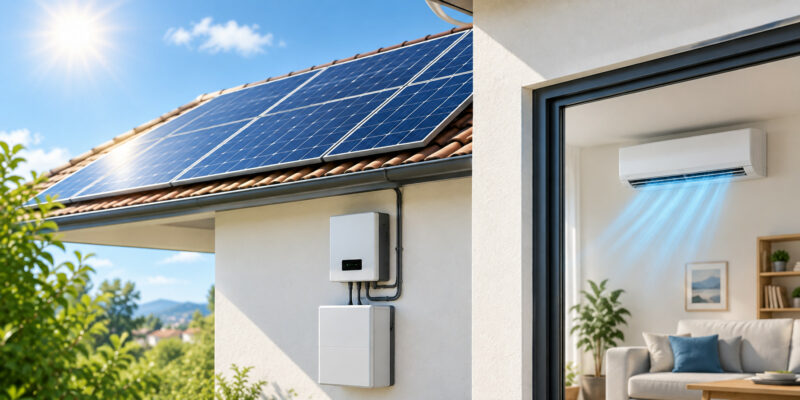
In Marbella and the rest of the Costa del Sol, air conditioning also means that summer consumption coincides with the hours of highest production, which increases self-consumption.
Frequently Asked Questions
How many years does it take for solar panels to pay for themselves?
In Málaga and Murcia, between 4 and 7 years. With the income tax deduction, 4-5 years is normal. Without grants, 6-8.
What return do solar panels give?
Between 13% and 20% per year in a well-sized installation. With the income tax deduction it can exceed 20%.
How long do solar panels last?
Manufacturers guarantee 25 years of production, usually with at least 85% of the initial output at the end of that period. Many keep working for 30 years or more. The inverter is usually replaced once, after 10-15 years.
Is it worth adding a battery to pay off the panels sooner?
No. A battery lengthens the payback period by 2-3 years. It makes sense for convenience, to have electricity during a power cut or if your consumption is mainly at night.
Do the panels pay off if I am rarely at home?
Less well. If the house is empty at midday, most of the production is sold as surplus at a low price. In that case it is worth scheduling appliances, considering a virtual battery or sizing a smaller installation.
How do I know how much I will save?
With your annual consumption in kWh and the orientation of your roof, it can be calculated quite accurately. That is what we do in the free study. You will find more answers in our frequently asked questions about solar panels.
Want to know how many years it would take for solar panels to pay off in your home? Request your free study with the calculation based on your bill. We install in Málaga, Marbella, Murcia and the rest of Spain.